
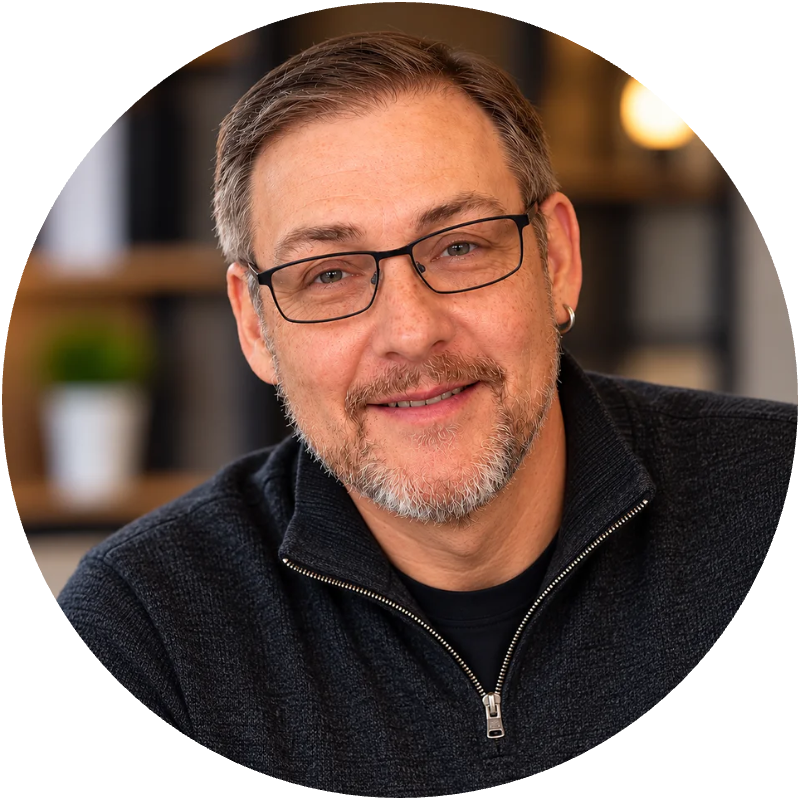
About Andrew Weinberg
Twenty-five years of programs where failure has a price tag.
I’m a principal technical program manager. I’ve spent my career on the programs where downtime has a dollar figure, a patient, or a headline attached to it: M&A integrations, hospital cutovers, platform turnarounds, and infrastructure built for global scale.
The short version
What I do, in two paragraphs.
I started at Microsoft in the late 1990s, helping build the infrastructure behind Windows Update, which grew into one of the ten most visited sites on the internet. Since then I’ve led enterprise programs across healthcare, logistics, SaaS, and telecommunications: moving a hospital and 13 clinics between health systems in a 12-hour cutover, cutting downtime 80% on logistics systems where outages cost $1.5 million a day, and running M&A integrations where two companies have to become one without the business noticing.
Most recently, I led three of the five IT integration workstreams for Inseego’s acquisition of Nokia’s Fixed Wireless Access business (identity and end-user computing, network and infrastructure separation, and security and compliance) for roughly 100 people across 20 countries. I also take on a small number of advisory engagements through my firm, Adaptive Technology Group.
Where the experience comes from
The programs that shaped how I work.
Microsoft
Windows Update
I was handed a blank slate: build the infrastructure for Windows Update. There was no playbook for always-on, globally redundant web infrastructure at that volume, so we wrote one. Active-active datacenters, DNS work with F5 that became foundational to global availability, and runbooks as serious as the architecture.
Lesson: design for contained failure, and treat documentation as infrastructure.
Healthcare IT
Ardent Health / SCL Health, Vanderbilt, Jefferson / Einstein
I moved St. Francis Hospital and 13 clinics from one health system to another, two Epic instances and two interface engine versions included, in 12 hours of planned downtime. I advised Vanderbilt University Medical Center through an Epic implementation and a Windows 10 migration across 22,000 endpoints, and ran a disaster recovery and business continuity transformation for Thomas Jefferson University and Einstein Healthcare Network.
Lesson: the quality of the night is decided by the months of preparation before it.
Asurion
Logistics platform turnaround
The back-end systems behind automated shipping were failing, and every day of downtime cost $1.5 million in EBITDA exposure. I started with the business impact model, not the root cause, then sequenced a structured modernization the business could absorb. Downtime fell 80%.
Lesson: urgency is only useful once it has structure.
Qualifacts
Two acquisitions at once
I onboarded two acquisitions in parallel, with different stacks, cultures, and contracts. We ran integration as its own program with its own governance, risk framework, and executive reporting line, not as a side workstream.
Lesson: integration is a program, and culture is a technical risk.
Inseego
Global carve-out, most recent
Separating Nokia’s Fixed Wireless Access business into Inseego meant identity, networks, labs, and offices across China, India, the Netherlands, and more, under GDPR, PIPL, India’s DPDP Act, and U.S. export controls at the same time.
Lesson: at global scale, compliance isn’t a phase. It’s the program.
How I work
Senior technical program management isn’t coordination. It’s structured leadership under uncertainty.
Make risk legible
Status tells you what happened last week. Risk tells you what’s about to matter. I brief leaders on exposure, options, and the decision they need to make, and by when.
Force tradeoffs into the open
Speed or reliability, scope or stability. Unnamed tradeoffs still get made, just by whoever is under the most pressure that week. I name them and get a decision on record.
Design for contained failure
Something will behave differently in production. What matters is how small the blast radius is when it does, and whether the rollback path has been tested.
Rehearse the hard parts
The first time a rollback runs should never be during a live incident. Rehearsal is expensive; uncontrolled failure costs more.
If a program feels easy, it’s either small, or the risk hasn’t surfaced yet.
Beyond the program
I’m based in the Greater Nashville, Tennessee area and spend a lot of time in Las Vegas, Nevada. Alongside my program work, I run Adaptive Technology Group, the IT consulting firm I contract advisory engagements through, and I serve as CIO/CTO for Enrichment Investments, a small portfolio of short-term rental properties and a neighborhood laundromat. Running the technology for a small business, where an outage lands on a customer at the counter, keeps me honest about what “operational impact” really means.
I’m finishing a B.S. in Cybersecurity and Information Assurance at Western Governors University, and I hold Certified ScrumMaster, Lean Six Sigma White Belt, and CompTIA Project+ certifications, with the PMP in progress.
Short bio
Andrew Weinberg is a principal technical program manager with more than 25 years of experience leading high-stakes enterprise programs across healthcare, logistics, SaaS, and telecommunications. He helped build the infrastructure behind Microsoft’s Windows Update, has led hospital divestiture cutovers and M&A integrations, and writes about technical program leadership at andrewweinberg.us. He is based in the Greater Nashville, Tennessee area.
Feel free to use this for introductions and event listings.
Where to go from here
Pick the path that fits why you’re here.
Hiring for program leadership
I’m open to conversations about full-time and contract principal TPM and program leadership roles.
Need a program steadied
Fractional program leadership and independent risk reviews, contracted through Adaptive Technology Group.
Here for the writing
Field notes on cutovers, M&A integration, dependency mapping, and translating technical risk for executives.